
Bought your first place in Ajax? Congratulations. Also: sorry about that first winter gas bill.
If your new home’s upstairs is freezing in January, the second floor bakes in July, or the heating bill made you do a double-take, there’s a good chance the attic is the reason — and there’s a good chance nobody’s looked at it in years.
This is the plain-language version. No jargon, no upsell, just what a new homeowner actually needs to know about the space above your ceiling.
Why the attic, of all places?
Heat rises. Simple as that.
In winter, all the heat you’re paying for drifts upward. If the attic above your ceiling is doing its job, it holds that heat in the house. If it isn’t, the heat escapes through the roof and you pay to make more, all winter long.
In summer, it works in reverse: the sun bakes the roof, the attic superheats, and that heat radiates down into your bedrooms. A good attic buffers both directions. A poor one buffers neither — which is why the same upstairs rooms are freezing in winter and stifling in summer.
For most Ajax homes, the attic is the single biggest, cheapest place to fix comfort and cut the bill. That’s the good news for a new owner: it’s usually the best-value upgrade you can make.
“How do I even know if mine is bad?”
You can check it yourself in about five minutes. No tools beyond a ruler and a flashlight.
- Find the attic hatch — usually a square panel in a closet ceiling or hallway
- Open it, shine a light in, and look. Do NOT climb in or step on the fluffy stuff — step only on the wooden beams (joists) if you go up at all
- Look at how deep the insulation is. Push a ruler straight down into it at a few spots
- Compare to this:
| What you measure | Roughly what it means |
|---|---|
| Less than 6 inches | Well below standard — you’re losing a lot of heat |
| 6–10 inches | Below where it should be — worth topping up |
| 12–16 inches | Getting there |
| 16+ inches | In good shape (depending on material) |
The quick gut-check: if you can easily see the tops of the wooden joists poking out above the insulation, you probably don’t have enough. A well-insulated attic buries them.
What you’re aiming for: in insulation terms it’s called R-60 (think of R-value like the tog rating on a duvet — higher is warmer). For most Ajax homes that’s roughly 16–18 inches of blown insulation. There’s also a lower number, R-50, that’s the minimum to qualify for the government rebate — more on that below.
Why your newer Ajax home might still be under-insulated
New homeowners are often surprised by this. “The house isn’t even that old — how can the insulation be bad?”
Two reasons, and both are common in Ajax’s subdivision housing:
It was built to the minimum of its time. When your home was built, it was insulated to the standard required then. Standards have risen over the years, so a home from the 1980s, 90s, or even 2000s often started below where an attic sits today. It was correct at the time — it’s just not much by current standards.
Insulation settles. The fluffy stuff compresses over years — under its own weight, under dust, sometimes under a previous owner’s storage boxes. So even if it started okay, what’s up there now is thinner than it was. The depth you measure today is the real number, not whatever the original spec said.
Add in Ajax’s lakeshore exposure — wind coming off Lake Ontario drives cold air harder against a house — and a thin attic gets exposed fast.
The stuff nobody tells first-time buyers
A few things that surprise new homeowners, all common in Ajax homes:
You usually don’t have to remove the old insulation. As long as it’s dry and clean (no mould, no water damage, no signs of mice), new insulation goes right over the old and the two add together. Removal is only needed if it’s contaminated. Attic insulation removal → — for the cases where it is.
Air leaks matter as much as insulation. Your ceiling has lots of little holes you can’t see — around light fixtures, pipes, wiring, the attic hatch. Warm air escapes through them, carrying your heat and (worse) moisture into the attic. Sealing those comes before adding insulation. A contractor who skips this is doing half the job.
Those little vents at the roof edge matter. The attic needs to breathe — air comes in at the eaves (the roof’s edge) and out near the peak. If insulation blocks the intake vents, you get moisture, frost, and ice buildup on the roof edge in winter (those icicles aren’t charming — they’re a warning sign). Small plastic pieces called baffles keep the vents clear. Baffle installation →
The bathroom fan might be dumping into the attic. Weirdly common. It should vent all the way outside, not just into the attic space — otherwise it’s pumping shower steam onto cold wood every day. Worth checking.
That cold room over the garage? Not an attic problem. If your new place has a bedroom or bonus room over the garage that’s always freezing, that’s because its floor sits over an unheated garage — not under the attic. Adding attic insulation won’t fix it. It needs the garage ceiling done. Garage ceiling insulation →
What actually gets done in a proper attic job
So you know what you’re paying for:
- Someone comes and measures — depth, what material’s there, the condition, the venting
- They seal the air leaks in the ceiling first
- They put in baffles to keep the roof-edge vents clear
- They insulate and seal the attic hatch (usually a bare panel — a literal hole in your ceiling)
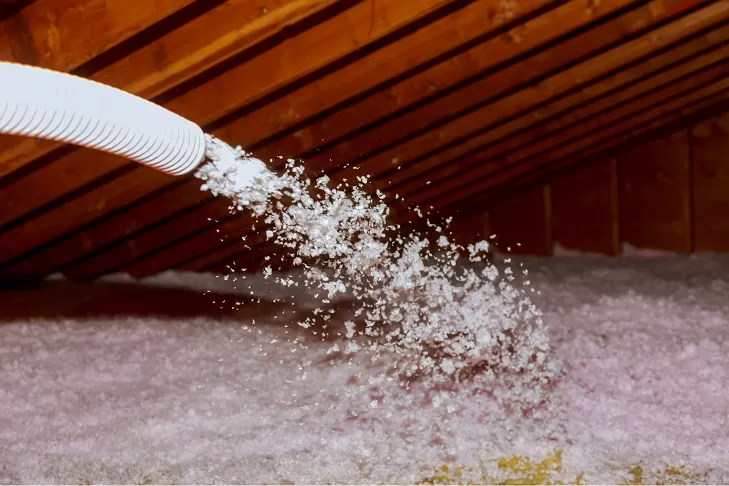
- They blow in insulation to the target depth, all the way to the edges
- They should mark the depth so you can see it was actually done to spec
Two materials do the job, both fine, both rebate-eligible:
- Cellulose — recycled paper, denser, a bit better at stopping air movement, needs a little less depth. Cellulose →
- Fibreglass — lighter, often a little cheaper for the same warmth. Fibreglass →
Your contractor should recommend one based on your attic and tell you why. Either is a solid choice.
One more: if your home has ductwork running through the attic (some do), those metal ducts should be insulated too — otherwise you’re heating the attic instead of your rooms. Blanket wrap →
Frequently asked questions
I just bought the house — is this urgent? Not an emergency, but it’s usually the best-value comfort-and-savings upgrade a new owner can make, and there’s a government rebate that makes it cheaper. Worth doing sooner than later, ideally before winter.
How much does it cost? It depends on your attic’s size, the material, and how much is already there — which is why any honest contractor measures before quoting rather than giving a phone price. Free assessments are standard.
Is there really a government rebate? Yes — Ontario’s Home Renovation Savings program. The amount depends on your current insulation level and your project cost. Full rebate guide for Ajax →
Do I have to leave the house while it’s done? No. You can stay home.
How long does it take? Most attic top-ups are done in a single day.
How do I know a contractor isn’t ripping me off? They should measure before quoting, put the scope in writing (including air sealing and baffles, not just “blow in insulation”), and show you the finished depth. If they won’t, keep looking.
Start with a free assessment — no pressure
As a new homeowner, the smartest first move is just to find out what you’ve actually got up there. A proper assessment measures your existing insulation, checks the venting and air leaks, and tells you plainly what — if anything — your attic needs.
Pro Insulation Contracting has insulated Ontario homes for over 10 years and serves Ajax and Durham Region. Free on-site assessment, written scope, fixed price before any work starts. No jargon, no pressure.
📞 (416) 315-0471 · Book a free attic assessment →

